

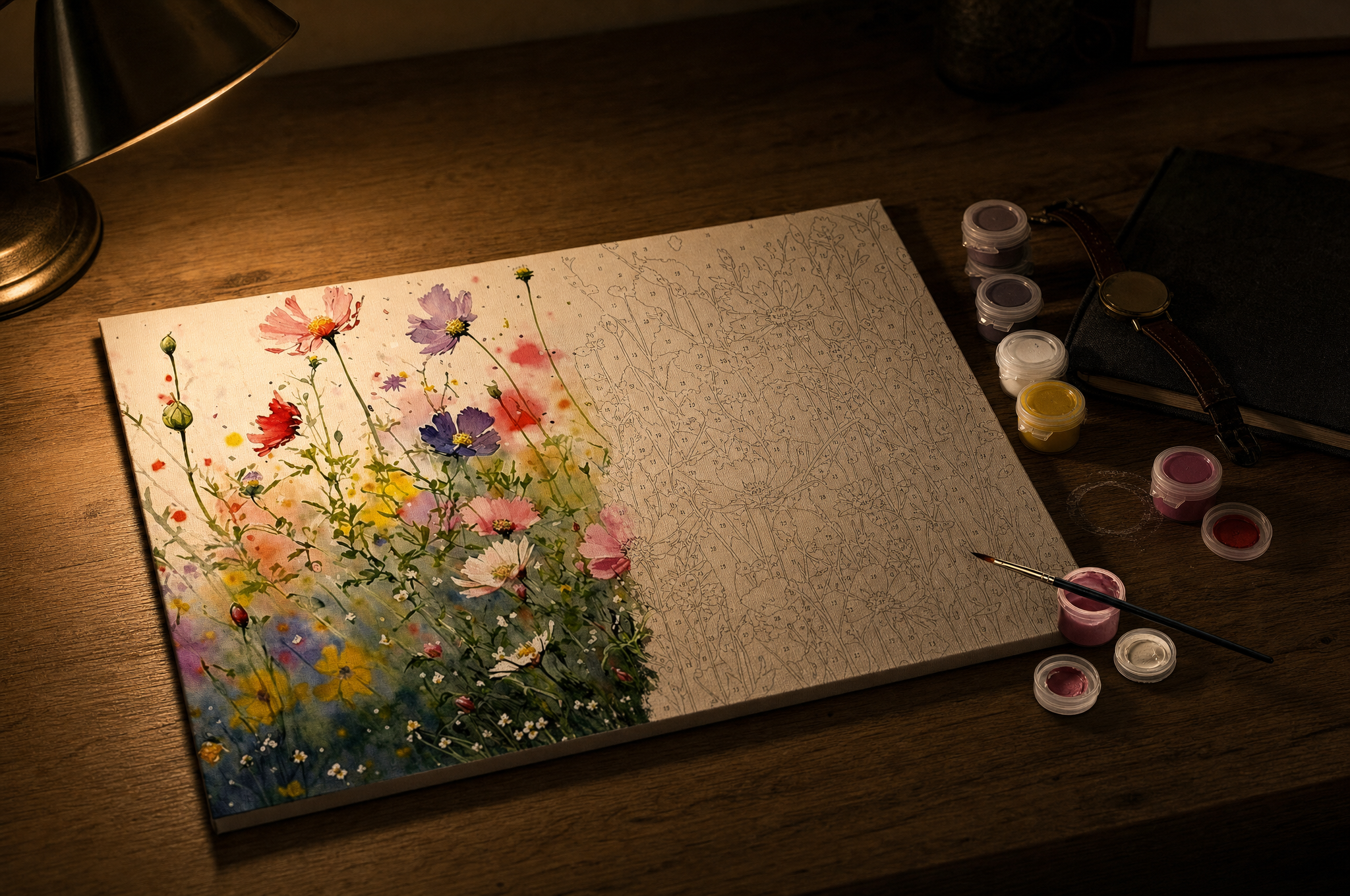
There is no reliable completion time for every paint-by-numbers kit. Canvas dimensions alone do not tell you how many small shapes, colour changes or second coats a design needs. The most useful estimate comes from a timed sample of your own canvas, then adding setup and finishing time.
Estimate your painting time from a sample
- Choose a small area containing both larger shapes and fine details, rather than timing only an easy background.
- Record how many minutes you actually spend painting. Keep setup, breaks and cleaning separate.
- Estimate how much of the canvas that sample represents. Use a rough area estimate, not a count of colours or paint pots.
- Divide the painting time by the completed fraction, then adjust if the remaining areas are more detailed.
Worked example—not an average: if 30 minutes covers about one-twentieth of a similarly detailed canvas, the estimate is 30 × 20 = 600 minutes, or 10 painting hours. At three 30-minute sessions a week, that would take about seven weeks of painting sessions, before allowing for interruptions or finishing. Your design may be faster or slower.
Why the estimate changes
- Small sections: each boundary needs control even when it uses little paint.
- Different detail across the canvas: a broad sky may not represent a face, foliage or patterned area.
- Coverage: some areas may need another coat after drying.
- Your pace: lighting, reach, breaks and comfort change how long a session remains enjoyable.
Repeat the estimate after a second session. If the two samples differ substantially, keep a range rather than turning the faster result into a deadline.
Painting time is not the same as elapsed time
Allow separately for opening and closing supplies, brush cleaning, drying between coats, and any finishing or framing. GOLDEN's technical notes explain why paint thickness, airflow, humidity and temperature affect acrylic drying. They are not a drying-time guarantee for an Artistry Rack kit; follow the actual paint and finishing-product instructions.
Make a short session easier to start
- Keep the reference image and numbered canvas photo together.
- Choose the next section before putting the kit away.
- Close unused paint pots and keep the working area clear.
- Use a brush suited to the section rather than rushing with an oversized brush.
For brush control and coverage, use our beginner painting guide. Keep your session notes in a simple project record so the next estimate uses your own progress.
If you are painting a gift
Work backward from the date you need the finished piece, allowing for the current checkout delivery estimate, your session plan, drying and framing. Do not rely on a delivery estimate quoted in an old blog. If the schedule is tight, consider giving the unopened kit instead of promising a finished painting.
Frequently asked questions
Can I finish a kit in a weekend?
Possibly, but we cannot promise that for a particular design. Time a representative section and compare the estimated painting hours with the time you actually have.
Does sharing a canvas halve the time?
Not necessarily. You may need to coordinate space, colours and wet areas. Treat shared painting as a different way to enjoy the project, not a guaranteed speed increase.
Does a larger canvas always take longer?
No. A smaller image with dense detail can require more careful work than a larger image with broad areas. Compare the pattern as well as the dimensions.
Before choosing a kit, look for a design you want to spend time with—not an unverified promise of how quickly it can be completed.